
FST-7
LEGS
FST-7 Leg Day Philosophy
Legs are the most demanding, most rewarding, and most neglected muscle group in bodybuilding. This FST-7 session attacks all four regions of the lower body — quadriceps, hamstrings, glutes, and calves — through a deliberately sequenced combination of heavy bilateral compound loading, unilateral correction work, and targeted isolation. The quad fascia is among the thickest in the body; the FST-7 leg extension finisher creates a pump so severe it physically forces adaptation through fascial expansion. This is not a comfortable session. It is a productive one.
Warm-Up Sequence — Leg Day Priority
Stationary Bike — 8 min, low resistance: Non-negotiable. The knee joint requires sustained synovial fluid circulation before any loaded flexion. Cold squatting is one of the most common causes of knee injury in the gym. Start at an easy cadence and gradually increase to moderate intensity by minute 5.
Hip 90/90 Stretch — 60 sec per side: Sit on the floor with both legs bent at 90°, one in front, one to the side. Lean forward over the front leg. This opens the hip joint capsule and releases the hip flexors and external rotators — critical for squat depth and knee tracking.
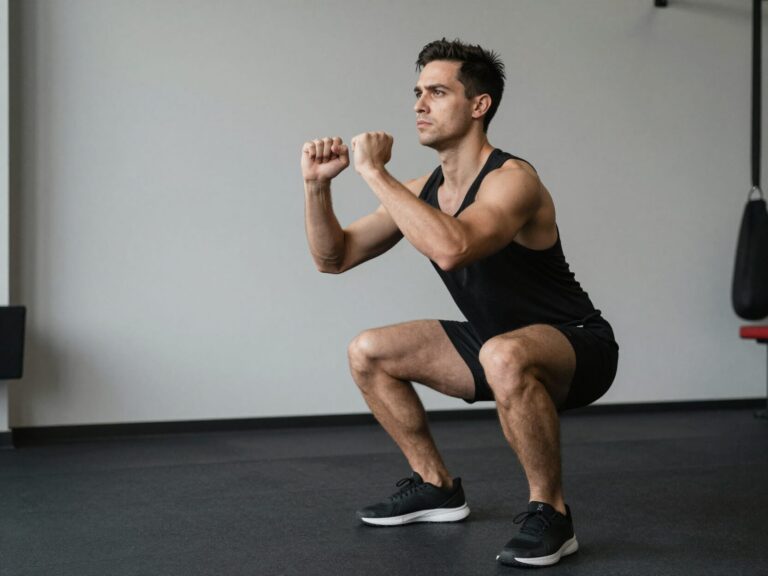
Bodyweight Squat — 2×20, slow tempo: Use a 4-second descent, pausing 2 seconds in the hole. This grease-the-groove warm-up technique activates the VMO (teardrop muscle), glutes, and adductors through the full range of motion before loading.
Glute Bridge — 2×15, hold top 2 sec: Activates the glutes and posterior chain before quad-dominant work. Prevents the knees from collapsing inward during squats and presses.
Leg Curl Machine — 2×15 (very light): Primes the hamstrings and biceps femoris through the full stretch-to-contraction range. Reduces hamstring tear risk on subsequent compound lifts dramatically.
Ankle Circles + Calf Raises — 30 sec each foot: Ensures full dorsiflexion for deep squat mechanics. Limited ankle mobility is a hidden cause of poor squat depth and forward knee collapse.
Setup — The Foundation of Every Rep
Bar position: high bar (on upper traps, above rear delts) for maximum quad emphasis. Low bar shifts load to the hips and is better suited to powerlifting. Feet shoulder-width, toes pointed out 25–35°. Before unracking, take a deep belly breath, brace the core like you're about to be punched, squeeze the glutes, and create full-body tension. The descent begins with a simultaneous knee push-out and hip hinge — not a straight-down drop.
Depth, Descent, and Drive
Descend to below parallel — hip crease must break below the top of the knee on every rep. A 2-second pause at the bottom eliminates the stretch-reflex bounce, maximizes time-under-tension, and dramatically increases quad and glute fiber recruitment. Drive out of the hole by pushing the floor away and driving the hips forward. Keep the chest tall throughout — forward lean indicates insufficient ankle mobility or excessive hip-dominance. Never allow knees to cave inward on the ascent.
Loading Strategy
Pyramid: 50%×10, 70%×6, 85%×4, then 4 working sets at 88–95% of your training max. The final set should be RPE 9.5+ — leave nothing. Use a lifting belt on all working sets (not warm-ups — the belt should not replace bracing ability). Use knee sleeves for warmth and proprioception. Straps are not applicable here, but wrist wraps are beneficial for lifters who feel wrist strain during high-bar positioning.
⚠ Knee & Spinal Safety
Never squat with a rounded lower back (butt wink) under load. If your hips tuck under at the bottom, improve hip and ankle mobility before adding weight. Ensure your knees track over your toes — not caving inward — throughout the entire rep. If knee pain is present, switch to a heel-elevated squat variation or hack squat until mobility improves.
Foot Position Controls Emphasis
Low and narrow placement maximizes quadriceps recruitment — the knee must travel further over the toe to reach depth, creating maximum quad stretch and knee flexion. High and wide placement shifts emphasis to the glutes and adductors. For this exercise, feet stay at or just below the midpoint of the platform, shoulder-width apart, toes slightly flared. Lower the platform until your knees reach 90° or beyond — never allow the lower back to peel off the seat at the bottom.
Never Lock Out
Stop the ascent just short of full knee extension on every rep — this keeps constant tension on the quadriceps and dramatically reduces knee joint shear forces. Locking out on each rep removes tension, reduces TUT, and places load on the joint rather than the muscle. On the final set, perform a rest-pause: go to failure, rack, breathe 5 times, continue to failure again. This is one of the most effective quad overload techniques available.
RDL vs Conventional Deadlift
The Romanian Deadlift does not touch the floor between reps — the bar descends to mid-shin or below, maintaining constant hamstring tension throughout the set. Start from standing, push the hips back while maintaining a neutral spine and soft knees (15–20° bend). The bar stays close to the legs (shins then quads) the entire time. The movement is a pure hip hinge — not a squat, not a back bend. Lower until you feel a deep hamstring stretch, then drive the hips forward to return to standing. Never round the lower back.
The 2-Second Stretch Pause
At the bottom of every rep, pause 2 full seconds in the deep hamstring stretch position. This eliminates momentum and forces the hamstrings to work eccentrically under maximum tension — the primary stimulus for hamstring hypertrophy. Most people rush through the stretch phase, dramatically reducing the effectiveness of this movement. Use straps from set 2 onward — grip should never be a limiting factor here.
Execution — Hips Down Is Non-Negotiable
Lie face down with the pad just above your heels. Press your hips firmly into the bench and keep them there for the entire set. Raising the hips during the curl brings the glutes into play and reduces hamstring isolation significantly. Curl until the pad touches your glutes — full contraction, hold 2 seconds — then lower for 3 seconds to a full stretch. Point toes slightly downward (plantarflexed) to increase the stretch on the gastrocnemius, which increases the biomechanical disadvantage and forces more hamstring work.
Unilateral Drop on Final Set
Perform set 3 to failure with both legs. Then immediately switch to single-leg curls — perform as many reps as possible with the weaker leg first, then the stronger. This exposes any bilateral strength deficit and is one of the most effective hamstring intensification techniques available.
Why Bulgarian Over Lunges
The elevated rear foot creates a deep hip flexor stretch on the trailing leg while allowing a much greater range of motion on the working leg than a standard lunge. This combination of hip flexor lengthening and glute loading under a deep stretch is unmatched for glute hypertrophy. Front foot should be positioned far enough forward that at the bottom, your front shin remains vertical (not angled forward). This shifts the majority of the load to the glute rather than the quad.
Torso Angle Controls Emphasis
Upright torso = greater quad emphasis. Forward lean = greater glute emphasis. For FST-7 leg day (which already has significant quad volume), use a moderate forward lean of 20–30° to shift the stimulus toward the glutes and provide full posterior chain development. Lower until the back knee nearly touches the floor — this full depth is what makes the Bulgarian so effective. Perform weaker leg first on all sets.
The Full ROM Requirement — Most Calves Are Undertrained Because of This
The single biggest mistake in calf training is insufficient range of motion. Calves contain a high proportion of slow-twitch, fatigue-resistant fibers that respond best to full-range, high-rep training with a complete stretch at the bottom and a full peak contraction at the top. Lower the heel as far below the step as possible — hold the deep stretch for 2 full seconds. Rise to maximum height — hold the peak contraction for 2 full seconds. Never bounce at the bottom. This 2-2-2-2 tempo (up-hold-down-hold) is brutal but is the only way to force adaptation in stubborn calves.
Foot Rotation Protocol
Set 1 — neutral feet (straight ahead): hits both medial and lateral heads equally. Set 2 — toes turned out: biases the medial (inner) head. Set 3 — toes turned in: biases the lateral (outer) head. Set 4 — neutral again, increase weight. Rotating foot position across sets ensures complete gastrocnemius development and prevents the imbalanced, "banana" calf shape.
Why Seated Is Completely Different
When the knee is bent at 90°, the gastrocnemius (which crosses the knee joint) is fully slackened — it cannot contribute meaningfully to the movement. This isolates the soleus almost exclusively. The soleus is the deeper calf muscle that creates the "push" and fullness from the side. Many bodybuilders with impressive gastrocnemius development have underdeveloped soleus muscles, creating a flat appearance from the side. Seated calf raises fix this entirely. The same 2-2-2-2 tempo applies: full stretch hold + full contraction hold on every single rep.
Why the Leg Extension is Ideal for Quad FST-7
The leg extension provides constant tension throughout the full arc — maximum load at both the fully shortened (extended) and fully lengthened (flexed) positions. After 5 prior exercises, the quads are substantially pre-fatigued, meaning a moderate weight will generate a pump of extraordinary intensity. The quad fascia (the rectus femoris fascia specifically) is among the thickest fascial sheaths in the human body — it responds enormously to this type of high-pump, high-frequency blood-flooding protocol. The peak contraction hold at the top of each rep is not optional: it creates the isometric stress that, combined with the pump, directly forces fascial expansion.
The FST-7 Leg Extension Protocol
Adjust the machine: shin pad just above the ankle, seat back positioned so the knee joint aligns with the machine's pivot. Select a moderate weight — approximately 50–60% of your normal working weight. After 5 prior exercises, the quads are pre-fatigued and this will feel much heavier than usual. Starting too heavy is the most common FST-7 error.
Fully extend the leg to lockout and hold for 2 full seconds, consciously squeezing all four quad heads as hard as possible — especially the VMO (inner teardrop). Lower slowly over 3 seconds until the ankle pad is at the bottom, feeling the full quad stretch. Every rep: 2 sec hold at top, 3 sec eccentric. No bouncing at the bottom. This is 100% about quality — not speed.
After each set, rest 30–45 seconds strictly. During rest, perform the FST-7 quad stretch: stand, reach behind and pull one foot to your glute, driving the knee back as far as possible. Hold 15–20 seconds per leg. This intra-set fascial stretch — while the quads are engorged with blood — is the defining mechanism of the entire session.
Repeat for all 7 sets. By sets 4–7 the quad pump will be severe and painful. This is expected and productive. If the pump causes cramping, slightly reduce weight and continue — cramping indicates the fascia is under maximum distension. Do not skip the final sets — this is where the greatest adaptive stimulus occurs.
After the final 7th set, immediately perform an extended wall-assisted quad stretch for 60 seconds per leg: face a wall, step close, pull the heel to the glute while pressing the hip forward. This keeps the fascia in the expanded position while consuming post-workout nutrition. Eat within 15 minutes of the final set.
Intra-Set Stretching Protocol (Between Every Set)
Standing Quad Stretch (Primary): Pull heel to glute, drive knee back past hip line. 15 sec per leg. Perform on both legs every set. The quad stretch is the single most effective way to expand the rectus femoris fascia while it is pumped.
Kneeling Lunge Hip Flexor Stretch: Drop one knee to the floor, shift hips forward and upright. 10 sec per side. Simultaneously stretches the rectus femoris (which crosses the hip) and the hip flexors — both deeply compressed under the FST-7 pump.
Wall-Assisted Deep Quad Stretch: Face the wall, step one foot close, pull the opposite heel to glute while pressing the hip into full extension. 10 sec. More intense than the standing version — use on sets 5–7 when the pump is at its peak.
Seated Hamstring Stretch (Between Last 2 Sets): Sit on the floor, extend both legs, reach forward. 15 sec. Relaxes the posterior chain, which allows the quads to pump even harder into the fascial space on the final sets.
Session Summary
Leg Muscle Coverage
All four lower body regions are directly trained. Quads receive the highest volume (squats, leg press, FST-7 finisher). Hamstrings via RDL + leg curl. Glutes via Bulgarian split squat and squat mechanics. Calves via standing (gastrocnemius) and seated (soleus) raises.
Volume by Muscle
FST-7 Leg Principles
Compound First, Always
Squats and RDLs while the CNS is fresh. Isolation and FST-7 come after the heavy compound work — never before.
Knee Tracking Every Rep
Knees must track over toes on every rep of every exercise. Knee cave is a biomechanical failure — reduce weight and fix immediately.
Full ROM or Nothing
Partial reps on leg day are wasted effort. Full depth on squats. Full stretch on RDLs. Full ROM on leg curls and extensions.
Embrace the Discomfort
The quad pump on FST-7 is extreme. Severe burning is expected — it means the protocol is working. Do not cut sets short.
Hydration — More Critical Here
Leg training demands more water than any other muscle group day. Aim for 30+ oz during the session. Cramping = dehydration.
Nutrition Timing
80–100g complex carbs (white rice, oats, sweet potato), 40–50g lean protein, minimal fat. Leg day burns more glycogen than any other session — carb intake must reflect this. Do not train legs in a fasted or low-carb state.
40–60g fast carbs (cluster dextrin, banana, Gatorade), 10g EAAs minimum. Begin consuming immediately — glycogen depletion starts from the first squat set. The FST-7 pump requires a carbohydrate surplus to maximize blood volume in the quad fascia.
50–60g whey isolate + 80–120g high-glycemic carbs (white rice, Cream of Rice, or a mass gainer). Leg day has the single highest post-workout nutrient demand of any training session. This is your biggest meal of the week — and the most important one.
40g casein or chicken + 60g complex carbs. Legs require longer recovery than upper body — extending the anabolic window with a secondary post-workout meal meaningfully improves recovery rate and reduces next-day soreness.
Post-Session Stretching
Wall-Assisted Quad Stretch
60 sec per leg. Pull heel to glute, press hip into full extension against wall. Most important post-session stretch — keeps the expanded fascia in a lengthened position.
Pigeon Pose (Glute/Hip)
60 sec per side. Lying or supported pigeon. Deeply stretches the gluteus maximus, piriformis, and hip external rotators — all heavily loaded during squats and Bulgarian split squats.
Standing Hamstring Stretch
45 sec per leg. Foot on a bench or box, hinge forward at the hip. Decompresses the hamstrings and biceps femoris after heavy RDL and curl volume.
Seated Calf Stretch (Both Variations)
Towel or band around foot, pull toward shin. 30 sec straight-leg (gastrocnemius), 30 sec bent-knee (soleus). Match the stretches to the exercises performed.
Foam Roll Entire Quad
Lie face down, roll from hip to knee slowly. 2 min total. FST-7 creates extreme quad tightness — foam rolling post-session dramatically reduces DOMS over the following 48 hours.
IT Band / Lateral Quad Roll
Roll lateral leg from hip to knee. 60 sec per side. Releases fascial adhesions in the vastus lateralis — a commonly tight structure after heavy leg press and squat volume.
Hey there! We hope you love our fitness programs and the products we recommend. Just so you know, Symku Blog is reader-supported. When you buy through links on our site, we may earn an affiliate commission at no extra cost to you. It helps us keep the lights on. Thanks.
Disclaimer: The information provided in this discussion is for general informational and educational purposes only. It is not intended as medical or professional advice. Only a qualified health professional can determine what practices are suitable for your individual needs and abilities.