
The Gilded Cage: When Spiritual Identity Becomes a Prison
On the quiet dangers of attaching too tightly to who we believe ourselves to be — and the false comfort of claiming metaphysical certainty in a universe that stubbornly resists it.
The most dangerous prisons are the ones whose bars are made of belief — because the prisoner holds the key and yet refuses to turn it.
— Adapted from psychological literature on identity rigidity
There is a particular kind of suffering that wears the clothes of liberation. It announces itself in the language of awakening, speaks in the vocabulary of higher truth, and wraps itself in the quiet authority of the spiritually initiated. It is the suffering of a self so thoroughly convinced of its own elevated nature that it becomes incapable of genuine growth, honest doubt, or authentic human connection. This is the suffering born from the fusion of personal identity with spiritual belief — and it is far more common, and far more corrosive, than most spiritual communities are prepared to acknowledge.
This essay is not an attack on spirituality, mystical experience, or the sincere search for meaning. The longing to understand one's place in the cosmos is among the most beautiful and distinctly human of impulses. What follows is a careful examination of what happens when that longing calcifies — when the seeking hardens into certainty, when the path becomes a brand, and when the map is mistaken for the territory it was only ever meant to describe.
Part I: The Architecture of Spiritual Identity
Identity is not a thing we have — it is something we continuously do. Psychologists from William James to Erik Erikson to contemporary self-concept theorists agree: the self is a dynamic, ongoing narrative construction, perpetually revised in response to experience, relationship, and reflection. This fluidity is not a flaw; it is the very mechanism by which human beings learn, adapt, and mature.
Spiritual identity, at its healthiest, works the same way. It is a framework — a lens, a language, a set of practices — that helps a person orient themselves in relation to meaning, mortality, and the broader mystery of existence. Understood this way, it is enormously valuable. The trouble begins when this framework stops being a tool and becomes a throne.
When we say "I am a spiritual person," we may mean something open and humble. But when that identity becomes load-bearing — when it is doing the heavy work of self-worth, social belonging, and existential security — something has quietly shifted.
At that point, any challenge to the framework is no longer an interesting intellectual provocation; it is an existential threat. The person is no longer testing their beliefs — they are defending their identity. And identity defense is one of the most powerful and distorting forces in all of human psychology.
How a spiritual path becomes a personality
The process is gradual and, for much of its duration, it feels entirely positive. A person discovers astrology, or energy healing, or a particular meditative tradition, or channeled cosmology. The discovery brings genuine insight. They feel seen, understood, aligned. A community forms around shared beliefs. The language of the tradition becomes their primary conceptual vocabulary. Others who share it feel like kin; those who don't can begin to seem dim, unconscious, or "not yet there."
Over time, the beliefs accumulate. They become not just perspectives but identifiers. "I am a starseed." "I am an empath." "I am an awakened being navigating a 3D world." "I am a healer who works in the fifth dimension." These statements do more than describe a belief — they describe a self. They confer status, explain suffering, and provide a narrative of specialness that can be enormously compelling, particularly for people who have experienced marginalization, trauma, or a pervasive sense that they have never quite fit in.
Researchers studying belief perseverance and identity-protective cognition have consistently found that when a belief becomes tied to self-concept, people process contradictory evidence not as information but as threat. The brain's threat-detection systems activate in ways strikingly similar to physical danger. This is not weakness or stupidity — it is a deeply wired human tendency that affects people across all ideological, intellectual, and educational backgrounds.
Part II: The False Comfort of Metaphysical Certainty
Alongside the question of identity sits a related and equally dangerous phenomenon: the desire for certainty in domains that are, by their very nature, uncertain. Human beings are spectacularly poor at sitting with not-knowing. The cognitive discomfort of ambiguity — what psychologists call intolerance of uncertainty — is one of the most well-documented drivers of belief adoption and belief rigidity in the research literature.
The metaphysical domain — questions about the fundamental nature of reality, consciousness, the soul, the afterlife, interdimensional beings, the structure of the cosmos — is precisely the domain in which uncertainty is not merely unavoidable but is, in a deep sense, intrinsic to the subject matter. These are questions that have occupied the greatest philosophical, scientific, and contemplative minds in human history. They remain open. They are likely to remain open.
This is not a failure of intelligence. It is an honest reflection of what these questions actually are — and of the limits of human cognition when applied to realities that may, by their nature, partially transcend that cognition.
The problem is that many spiritual and pseudoscientific communities offer precisely the opposite: confident, detailed, and highly specific claims about the nature of reality. They know what happens after death. They know how many dimensions there are. They know which celestial configurations govern personality. They know the identity of the beings communicating through particular channels. They know the hidden forces structuring history and disease and consciousness.
This certainty is intoxicating. And intoxication — however pleasant in the moment — impairs judgment.
The epistemological problem with pseudoscientific frameworks
Science, for all its limitations and its own institutional failures, has one defining virtue that pseudoscientific frameworks systematically lack: it is built around the capacity to be proven wrong. A scientific claim, by definition, must be falsifiable — it must be possible, at least in principle, to construct an observation that would refute it. This is not an arbitrary methodological quirk. It is the central mechanism by which knowledge is distinguished from mere belief, and by which error can be identified and corrected over time.
Pseudoscientific claims — in astrology, in crystal healing, in quantum consciousness theories that misappropriate physics, in energy work that posits unmeasurable forces, in channeled information from interdimensional sources — are structurally designed to resist falsification. When the astrological prediction doesn't come true, there are always other chart factors to blame. When the energy healing doesn't work, the patient's own vibrational blockages are at fault. When the channeled entity's prophecy fails to materialize, the interpretation was wrong, or humanity's free will changed the timeline, or the initiates weren't ready.
A belief system that can absorb every possible outcome as confirmation of its truth claims — including the outcomes that would seem to refute them — is not a description of reality. It is an ideology. This distinction matters enormously, not because ideology is inherently evil, but because confusing ideology for empirical truth about the nature of reality carries significant costs.
This is not to say that every claim in these domains is certainly false. Some aspects of traditional and indigenous knowledge systems have demonstrated genuine value that mainstream science took decades to acknowledge. The relationship between consciousness and physical reality remains genuinely mysterious. Some phenomena currently classified as anomalous may eventually receive more robust scientific explanations. Intellectual humility cuts both ways: it does not validate pseudoscience, but it does counsel against the reflexive dismissal of everything beyond the current scientific consensus.
The problem is not that these questions are being asked. The problem is that they are being answered — loudly, confidently, and with a certainty that the actual epistemic situation does not justify.
Part III: Seven Signs the Spiritual Self Has Become a Cage
The following patterns are not diagnoses. They are observations drawn from clinical psychology, philosophy of mind, religious studies, and the documented experiences of people who have navigated — and eventually moved beyond — rigid spiritual identity. They are offered not as condemnations but as mirrors.
-
Disagreement feels like an attack on your person
When someone questions your spiritual beliefs and you feel visceral defensiveness — disproportionate to the actual stakes of the conversation — the belief has likely fused with identity. Genuine intellectual confidence welcomes scrutiny; brittle identity masquerading as confidence deflects it.
-
The framework explains everything — including its own failures
If your belief system has an answer for why every disconfirming piece of evidence doesn't count, you are not in contact with a description of reality — you are inside a closed interpretive loop. Reality-describing frameworks have edges; they acknowledge what they don't know.
-
Relationships are sorted by belief alignment
When you find yourself organizing your social world primarily around spiritual tribe membership — drawing close to those who confirm your framework, gradually distancing from those who don't — you have begun using belief as a social sorting mechanism. This is a hallmark of cult-adjacent dynamics and group identity rigidity, regardless of how gentle the framework itself appears.
-
The narrative of your life centers on spiritual specialness
Frameworks that position adherents as specially awakened, vibrationally advanced, starseed visitors, or cosmically chosen fulfill a powerful psychological need for uniqueness and significance. When this narrative becomes load-bearing — when it's doing the work of self-esteem — the identity cannot safely be questioned without threatening the entire structure of self-worth.
-
Doubt is pathologized rather than honored
Healthy spiritual traditions across history have consistently honored doubt, dark nights of the soul, and the seasons of disbelief as part of genuine practice. When a community or personal framework treats doubt as a sign of vibrational lowering, unhealed trauma, or insufficient faith, it has replaced honest inquiry with ideological maintenance.
-
Medical, psychological, or legal concerns are filtered through the framework
One of the most concrete harms of rigid spiritual identity is the tendency to interpret physical or mental health symptoms through metaphysical lenses — as energy imbalances, spiritual attacks, karmic residue, or dimensional interference. This interpretation can delay or replace evidence-based care with consequences that are sometimes severe and occasionally fatal. The framework's explanatory reach should never extend to domains where empirical expertise exists.
-
Certainty increases rather than decreases over time
Genuine wisdom traditions — across Buddhism, contemplative Christianity, Daoism, Advaita Vedanta, and many others — broadly agree that deepening practice tends to increase comfort with mystery, paradox, and not-knowing. If your engagement with a framework has made you progressively more certain about the precise structure of reality, that is a flag worth examining. The universe does not become simpler the more honestly we attend to it.
Part IV: The Real Costs — Personal and Collective
These patterns carry costs that operate at multiple scales, from the deeply personal to the broadly social.
The personal cost: a foreclosed self
When identity is fused with belief, the self stops growing in the directions the belief doesn't permit. New evidence, challenging relationships, and genuinely transformative experiences get filtered — either absorbed into the framework or quietly avoided. The person may appear stable, even serene; in reality, the stability is the stability of the closed system, not the stability of genuine integration.
There is also the cost of lost relationships. The gradual narrowing of the social world to those who affirm the framework produces a kind of echo chamber that clinical researchers have linked to increasing extremity of belief over time. People who would have provided correction, challenge, and loving friction are slowly weeded out — often framed, from within the framework, as "low-vibration," "not yet awakened," or simply "not my people."
Researchers studying the intersection of spiritual seeking and trauma have noted a concerning pattern: communities offering highly detailed metaphysical frameworks that explain suffering as meaningful, karmic, or specially chosen are disproportionately attractive to people with histories of trauma, abuse, or profound disconnection. The framework can provide genuine relief — a narrative that makes suffering intelligible. But when it also prevents the processing of trauma through evidence-based therapeutic approaches, or when it is used by community leaders to maintain control, the same framework that offered comfort becomes a cage.
The collective cost: epistemic pollution
At the collective level, the widespread conflation of sincere spiritual seeking with confident pseudoscientific truth claims contributes to what philosophers have begun calling epistemic pollution — the degradation of shared norms around what counts as evidence, what standards justify belief, and how disagreement should be navigated.
This is not a trivial concern. Societies whose members cannot agree on basic standards of evidence — cannot, in the most practical terms, distinguish between "I believe this deeply" and "I have good reason to claim this is true" — face profound challenges in coordinating around genuine collective problems. The erosion of epistemic norms in spiritual communities does not stay within those communities; it seeds broader cultural tendencies toward motivated reasoning, conspiratorial thinking, and the rejection of expertise.
| Healthy Spiritual Engagement | Rigid Identity-Fused Belief |
|---|---|
| Holds beliefs as working hypotheses open to revision | Holds beliefs as revealed truths immune to revision |
| Welcomes honest doubt as part of the path | Treats doubt as a spiritual failing or vibrational blockage |
| Maintains diverse relationships across belief lines | Gradually narrows social world to belief-aligned peers |
| Draws clear boundary between metaphor and empirical claim | Consistently blurs metaphor with literal metaphysical assertion |
| Defers to relevant expertise for medical and legal matters | Filters all domains through the framework's explanatory lens |
| Deepening practice brings increasing comfort with mystery | Deepening engagement brings increasing certainty about reality's structure |
| Identity remains fluid, capable of growth and revision | Identity is defended against challenge as existential threat |
Part V: On the Genuine Value of Spiritual Practice — and Its Proper Place
Nothing in the preceding pages is meant to suggest that spiritual life is without value, that mystical experience is fraudulent, or that the longing for transcendence is a pathology. These are among the most distinctly human of experiences, and the traditions that have grown up around them carry genuine wisdom — about impermanence, about compassion, about the relationship between attention and flourishing, about the poverty of a life organized entirely around material accumulation and social status.
The contemplative traditions of the world's major religious and philosophical heritages — whatever their doctrinal differences — broadly converge on a remarkable set of practical insights: that ordinary egoic consciousness is limited; that attention can be trained; that compassion is both a moral virtue and a psychological resource; that clinging causes suffering; that there are dimensions of experience accessible through practice that are not accessible through mere conceptual thinking.
None of these insights require confident claims about interdimensional beings, the precise energetic structure of the chakra system, the predictive validity of natal charts, or the literal geography of the afterlife. The practical wisdom can stand without the metaphysical scaffolding. And the metaphysical scaffolding — held with the honesty it deserves — can be acknowledged as possibility, as evocative symbol, as working hypothesis, without being promoted to the status of known fact.
This distinction — between the lived practice and the doctrinal claim, between the transformative experience and the cosmological explanation — is perhaps the most important one available to the honest spiritual seeker. It is also, notably, the distinction that the most mature voices within spiritual traditions have themselves emphasized across centuries. The mystic who genuinely encounters the ineffable typically returns not with a detailed report on dimensional structure but with a humbled tongue and an expanded capacity for wonder.
Part VI: Toward a Spirituality of Openness
What would it look like to hold spiritual life in a way that neither requires defensive rigidity nor collapses into nihilistic dismissal? The following is not a prescription — the whole point is that any prescription would miss what it's aiming at. These are instead suggestions for orientation.
Hold beliefs like hypotheses, not like identities
A hypothesis is a serious thing. Scientists stake careers on hypotheses. They organize experiments around them. They feel genuine intellectual investment in them. But the hypothesis remains, by design, provisional — subject to revision in light of evidence. This is not wishy-washy relativism; it is intellectual honesty. Your spiritual framework can be something you genuinely invest in and practice without requiring it to be the last word on reality.
Cultivate genuine epistemic humility
Epistemic humility is not the same as epistemic cowardice (refusing to take any position to avoid controversy). It means holding your beliefs with appropriate confidence — more confidence where you have stronger grounds, less where you don't. The metaphysical domain is one where the honest answer to most questions is "I genuinely don't know, and I'm not sure it's possible to know." That honest answer is not a failure. It is the beginning of authentic inquiry.
Maintain your relationships across belief lines
One of the most practically useful tests of spiritual health is whether your community and closest relationships span belief differences. The person who challenges your framework is not your enemy. They are one of the most valuable presences in your epistemic life — assuming the challenge comes in good faith. A practice that can only survive inside an echo chamber has not yet proven itself against reality.
Let the identity stay loose
You can be someone for whom spiritual practice is central to life without that practice becoming a categorical identity that requires defending. Notice whether you introduce yourself primarily through your spiritual labels. Notice whether conversations with those outside your tradition feel subtly like evangelical moments. Notice whether a challenge to a belief produces hurt feelings rather than intellectual engagement. These are diagnostics, not condemnations — and noticing them, honestly, is itself a form of practice.
Conclusion: The Freedom on the Other Side
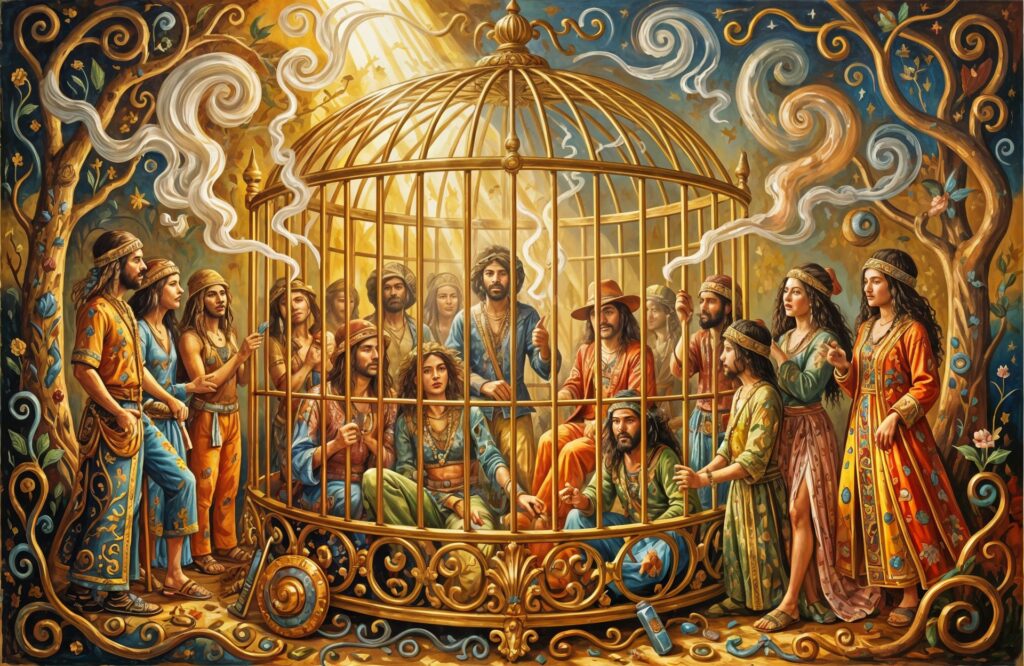
The title of this essay refers to a gilded cage — and it is worth sitting with that image for a moment. A gilded cage is beautiful. The person inside may genuinely love it. They may have chosen it, decorated it, and spent years making it their home. The bars may have provided genuine protection at some point. The difficulty of leaving is real, not imagined.
But a cage is still a cage. And the invitation — which is not demanded, because the choice belongs entirely to the person inside — is to notice the bars: to see them clearly, without shame, and to ask whether they are still serving the life that is trying to be lived.
The universe, by every honest account we have, is unimaginably vast, astonishingly strange, and genuinely mysterious in ways that should humble even the most confident of cosmologists. A spiritual life that honors that vastness — that holds its frameworks with appropriate looseness and its curiosity with appropriate tenacity — is not a lesser spiritual life than one organized around confident certainty. In the most important ways, it is a deeper one.
The goal, in the end, is not to have the right beliefs. It is to be genuinely alive to reality — which means remaining open to being surprised by it.

Hey there! We hope you love our fitness programs and the products we recommend. Just so you know, Symku Blog is reader-supported. When you buy through links on our site, we may earn an affiliate commission at no extra cost to you. It helps us keep the lights on. Thanks.
Disclaimer: The information provided in this discussion is for general informational and educational purposes only. It is not intended as medical or professional advice. Only a qualified health professional can determine what practices are suitable for your individual needs and abilities.