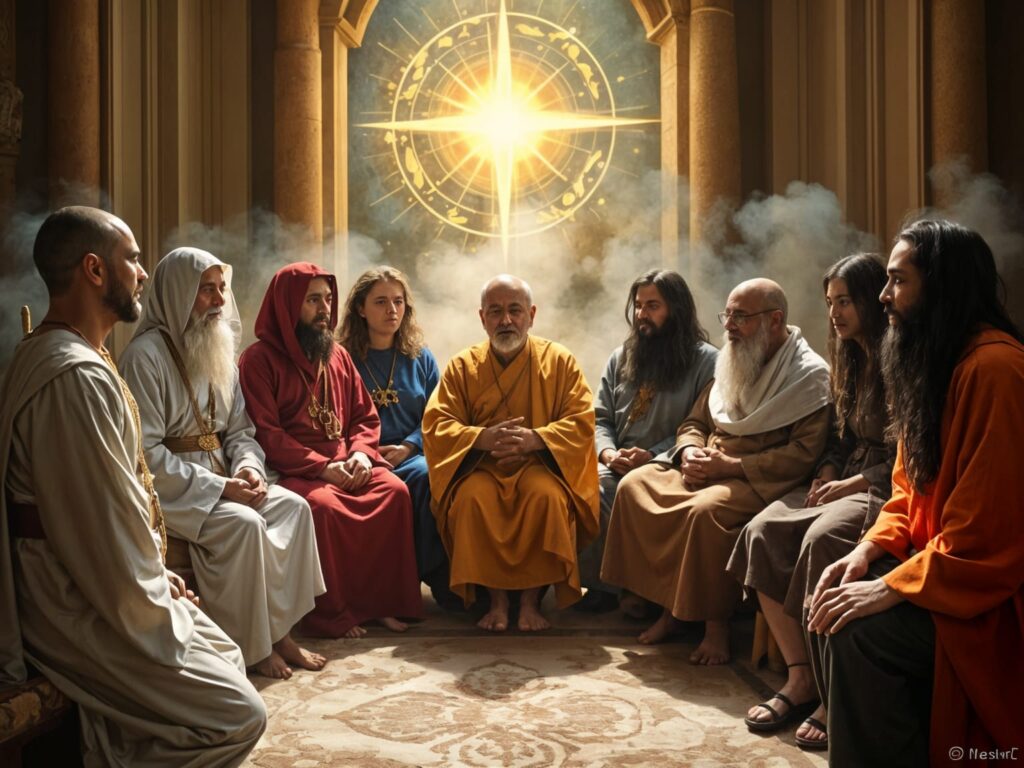
There’s a pattern that emerges when you start looking closely at spiritual authority across cultures and centuries. Whether you’re sitting in a medieval cathedral or attending a crystal healing workshop in a converted warehouse, you’re likely encountering the same fundamental dynamic: someone positioned between you and the infinite, claiming special access to what you cannot directly reach.
I call it “The Rabbit Hole Guild”—not to diminish either tradition, but to illuminate something profound about how humans organize their relationship with the transcendent.
The Mediator's Promise
The Catholic priest stands at the altar, consecrating bread and wine into the literal body and blood of Christ. This is no symbolic gesture in traditional theology—it’s transubstantiation, a metaphysical transformation that only an ordained priest can perform. The sacrament cannot happen without this intermediary. You, the congregant, need this person to access divine grace through the Eucharist.
The New Age channeler sits cross-legged, eyes closed, voice shifting into unfamiliar cadences as they claim to receive messages from Ascended Masters, ancestors, or extraterrestrial intelligences. They’re offering you access to cosmic wisdom that exists beyond ordinary perception. You, the seeker, need this person to hear what the universe is supposedly saying.
Both are making the same core proposition: I have access to something you don’t, and you need me to bridge that gap.
The Architecture of Spiritual Dependency
This isn’t coincidence. It’s architecture—carefully constructed over generations to create a specific kind of relationship.
In traditional priesthood, the structure is explicit and formalized. The Catholic Church developed an elaborate sacramental theology over centuries, establishing seven sacraments that mark crucial moments in a believer’s life: baptism, confirmation, Eucharist, confession, marriage, holy orders, and anointing of the sick. For most of these, you need a priest. The priest becomes the essential conduit—not through personal charisma necessarily, but through apostolic succession, an unbroken chain of ordinations stretching back to the apostles themselves.
The priest’s authority isn’t about individual enlightenment. It’s institutional. It’s transferred through ritual, maintained through hierarchy, and protected through doctrine. You can’t just decide to become a priest by studying scripture or having a profound spiritual experience. You need the Church to make you one.
New Age teachers construct a parallel architecture, though it looks nothing like traditional ecclesiastical hierarchy. The modern channeler or spiritual guide claims authority through different means: extraordinary experiences (near-death experiences, spontaneous awakenings, contact with non-physical entities), ancient lineages (Atlantean wisdom, indigenous teachings, Eastern mysticism repackaged for Western consumption), or special training (energy healing certifications, shamanic apprenticeships, mystery school initiations).
Where the priest says “I am ordained by the Church,” the New Age teacher says “I have been chosen by the universe” or “I have activated my light body” or “I have studied with masters in the Himalayas.” Different language, same function: establishing credentials for mediation.
The Economics of Access
Both systems create economies—literal and metaphorical—around access to the divine.
The medieval Church operated this explicitly through indulgences, fees for sacraments, and the promise that donations could reduce time in purgatory. The priest controlled access to salvation itself. Even after the Reformation challenged these practices, the basic economic relationship persisted: you support the religious institution financially, and it provides spiritual services.
New Age spirituality has monetized access differently but just as thoroughly. Want to learn to channel? That’s a $3,000 workshop. Need your chakras balanced? That’s $150 per session. Seeking to activate your Merkaba? Here’s a $500 online course. The language is about “energy exchange” and “honoring the sacred work,” but the structure is the same: pay for access to what you supposedly cannot reach alone.
Both systems discourage direct experience. The priest doesn’t generally encourage you to consecrate your own communion at home. The channeler doesn’t typically teach you that you could receive cosmic wisdom directly without paying for their guidance. The mediator’s value depends on maintaining the gap they claim to bridge.
The Theology of Separation
This mediator model rests on a theological assumption: you are separate from the divine, and that separation requires professional intervention to overcome.
Traditional Christianity inherited and elaborated this through the doctrine of original sin. Humanity fell, became fundamentally corrupted, and cannot restore its relationship with God through its own efforts. You need Christ’s sacrifice, accessed through the Church’s sacraments, administered by priests. The separation is metaphysically real and requires institutional mediation to bridge.
New Age spirituality theoretically rejects this—it often speaks of everyone being divine, of God/Source/Universe being within all of us, of the illusion of separation. But watch what happens in practice. You’re divine, yes, but you haven’t activated that divinity yet. You’re connected to Source, but your connection is blocked by trauma, limiting beliefs, uncleared karma, or insufficiently raised vibration. You need the teacher who has cleared these blocks, raised their frequency, and can now help you do the same—for a price.
The rhetoric celebrates your inherent divinity while the practice assumes your functional inability to access it without help. It’s separation theology wearing the costume of unity consciousness.
The Language of Mystery
Both traditions guard their status through specialized language that creates insiders and outsiders.
The Catholic Mass was conducted in Latin for centuries, ensuring that the congregation couldn’t fully understand what was being said. Even after Vatican II brought vernacular languages into the liturgy, theological terminology remains dense and inaccessible: transubstantiation, consubstantiation, hypostatic union, theotokos, filioque. The complexity serves a function—it marks territory that requires expert interpretation.
New Age teachers deploy their own lexicon: quantum fields, vibrational frequencies, dimensional shifts, akashic records, DNA activation, crystalline light bodies, 5D consciousness. Much of this language borrows scientific-sounding terms without scientific rigor, or appropriates concepts from Eastern religions without their original context. The effect is the same as Latin Mass: it creates a semantic boundary between those who speak the language and those who don’t, positioning the teacher as the necessary translator.
The Ritual of Transformation
Both systems offer rituals that supposedly transform you, but which you cannot perform for yourself.
Baptism washes away original sin—but only if a priest performs it with the proper intention and formula. The ritual’s efficacy depends on the ordained intermediary.
The New Age “attunement” or “activation” follows the same pattern. A Reiki master attunes you to channel Reiki energy, opening pathways that were supposedly closed. A spiritual teacher activates your kundalini, initiates you into a lineage, or adjusts your light body. You couldn’t do this yourself. You need the master who has the power to flip the switch.
The anthropological function is identical: creating transformation experiences that bind participants to the authority of the transformer.
The Heresy of Direct Access
Both systems have historically treated direct spiritual experience that bypasses the mediator as dangerous or heretical.
Christian mystics who claimed direct union with God often faced suspicion or persecution. Meister Eckhart was tried for heresy. Joan of Arc was burned at the stake partly for claiming direct communication with divine voices that didn’t require priestly interpretation. The Protestant Reformation itself was partly a movement toward “priesthood of all believers”—the radical idea that individuals could have direct relationships with God through scripture, without mandatory priestly mediation.
New Age communities rarely burn heretics, but they have their own mechanisms for managing direct experience that threatens the teacher’s authority. If you claim to have profound spiritual insights without going through the approved teachers, courses, or practices, you might be told you’re not properly grounded, haven’t done enough shadow work, or are channeling lower vibrational entities. The spontaneous awakening is reframed as incomplete or potentially dangerous without proper guidance—which, conveniently, the teacher can provide.
The Psychological Mechanics
Why does this pattern persist across such different contexts? Because it serves deep psychological needs on both sides of the equation.
For the mediator, the role provides identity, purpose, status, and often income. It answers the profound human question “What makes me special?” with “I have access to the sacred that others don’t.” It transforms personal spiritual experiences into social power.
For the seeker, the mediator offers relief from several anxieties. First, the anxiety of direct responsibility for one’s spiritual life. If salvation or enlightenment requires only your own effort, failure is entirely yours. If it requires the priest’s sacraments or the teacher’s initiations, failure can be attributed to not receiving enough of what only they can provide. Second, the anxiety of uncertainty. The mediator claims to know, to have mapped the territory, to understand what the divine wants. In exchange for following their guidance, you receive certainty. Third, the anxiety of isolation. Spiritual seeking can be lonely. The mediator provides community, shared language, and social belonging organized around the sacred.
The Unspoken Agreement
What emerges from all this is an unspoken agreement:
You (the seeker) agree to position me (the mediator) as necessary for your spiritual progress, and in exchange, I will provide structure, certainty, and community for your seeking.
Both parties benefit. Both parties maintain the pattern. The priest needs the congregant who believes salvation comes through sacraments. The New Age teacher needs the client who believes awakening comes through their guidance. The seeker needs the authority figure who will organize chaos into cosmos.
This isn’t necessarily exploitation, though it can become that. It’s a social contract about how to organize spiritual life.
The Alternative
The pattern has persisted for so long that imagining alternatives can be difficult. But they exist.
Some spiritual traditions have historically emphasized direct experience over mediation. Certain strands of Buddhism encourage practitioners to “be a lamp unto yourself.” Quaker worship centers on silent waiting for the “inner light” without professional clergy. Sufi poetry often celebrates direct, unmediated intoxication with the divine. Some forms of Christian mysticism pursue union with God that transcends institutional mediation.
In the modern context, some people are experimenting with spiritual autonomy—taking responsibility for their own direct investigation of consciousness, meaning, and transcendence without requiring intermediaries to validate or facilitate the journey. This isn’t about rejecting all teachers or guidance, but about refusing to outsource spiritual authority permanently to someone else.
The crucial distinction is between seeking temporary guidance from someone with more experience (reasonable) and establishing a permanent relationship of spiritual dependency where you cannot access the sacred without them (the mediator pattern).
Down the Rabbit Hole
So we return to the Rabbit Hole Guild—this persistent pattern of positioning someone between humans and whatever they consider transcendent.
The rabbit hole isn’t the spiritual seeking itself. It’s the assumption that seeking requires a professional guide who controls access to what you’re seeking. It’s the idea that you can’t trust your own direct experience without someone to interpret it for you. It’s the belief that the sacred is elsewhere, guarded by gatekeepers, rather than immediately available to your own sincere investigation.
The guild isn’t a conspiracy. It’s an emergent pattern that serves the psychological and social needs of everyone involved. Recognizing the pattern doesn’t require denouncing everyone who participates in it—priest and New Age teacher alike may be sincere in their beliefs and helpful to those they serve.
But recognizing the pattern does invite questions: What if you didn’t need an intermediary? What if direct access to your own deepest truth—whatever you conceive that to be—was your birthright rather than a privilege granted by someone else’s authority? What if the sacred was never separate from you in the first place?
These questions don’t have comfortable answers. They place responsibility directly on you, without the relief of outsourcing spiritual authority to someone else. They remove the buffer between you and the infinite.
Maybe that’s why the mediator pattern persists. The rabbit hole is comfortable once you’ve built a home in it. The guild offers security that spiritual independence does not.
But for those willing to climb out and stand in direct sunlight—however harsh and brilliant—the view from outside the rabbit hole reveals that the map was never the territory, and the guide was never the journey itself.
You are both the seeker and what you seek. You always were.
Hey there! We hope you love our fitness programs and the products we recommend. Just so you know, Symku Blog is reader-supported. When you buy through links on our site, we may earn an affiliate commission at no extra cost to you. It helps us keep the lights on. Thanks.
Disclaimer: The information provided in this discussion is for general informational and educational purposes only. It is not intended as medical or professional advice. Only a qualified health professional can determine what practices are suitable for your individual needs and abilities.