
“This post contains affiliate links. If you purchase through my links, I may earn a small commission at no extra cost to you.”
When Belief Becomes a Cage: My Six Years Inside Magical Ideation
A firsthand account of living with Schizotypy — crystal grids, tarot decks, cosmic identity, and the long road back to reality.
From November 2016 to sometime in 2022, I lived inside a world I had constructed entirely from belief. Not faith in the quiet, humble sense — but an absolute, unshakeable certainty that I was cosmically different. That I could perceive what others could not. That the universe was speaking directly to me, and I was fluent in its language.
Looking back now, I recognize what was happening: I was deep inside what psychologists call Schizotypy — and what I have come to call, more personally, Magical Ideation. This is my testimony.
What Is Magical Ideation?
Schizotypy is a personality dimension — not a disorder, but a spectrum of traits that can range from creative and spiritually sensitive to, at its more extreme end, deeply disconnected from shared reality. It includes unusual perceptual experiences, magical thinking, ideas of reference (the sense that unrelated events carry personal meaning), and cognitive-perceptual distortions.
Magical Ideation, as I define it from lived experience, is when the mind weaves everything — every symbol, every coincidence, every feeling — into a grand tapestry of personal cosmic significance. It feels like awakening. But it can also become a prison.
The Five Identity Traps of Schizotypy
- Inflation — Mistaking unusual perceptions for divine selection or cosmic status
- Literalism — Taking metaphorical and symbolic experiences as literal, factual truth
- Boundary dissolution — Losing the self/other distinction under the guise of spiritual "oneness"
- Confirmation bias loops — Using spiritual frameworks to validate every anomalous experience as meaningful
- Identity foreclosure — Building one's entire identity around spiritual experiences, making critical reflection impossible
I walked through every single one of those doors. And I stayed inside for six years.
Inflating the Ordinary Into the Divine
It began subtly. A meaningful dream here. A "coincidence" there. I started to notice patterns everywhere — in numbers, in conversations, in the way sunlight fell across a room. Rather than holding these experiences lightly, I did what schizotypy so readily invites: I inflated them.
I told myself I was clairvoyant. I didn't need to research anything, because I simply knew things. This felt like a gift. In reality, it was the first wall going up around critical thinking.
"I told myself that knowledge was something you felt, not something you verified. I was not seeking truth — I was seeking confirmation."
— From my own journal, circa 2018The certainty felt spiritual. It felt like wisdom. But certainty without curiosity is not wisdom — it is the closing of a mind.
The Tools of a Constructed Reality
To build a private cosmos, you need private instruments. Mine were tarot cards, astrological planet placements, and crystal grids. I used these not as cultural curiosities or psychological mirrors — but as literal mechanisms of healing. Physical illness. Mental struggles. Relationship troubles. I believed these tools could treat them all.
I also developed what I called "Connecting the Dots" — a personal system of correspondence where everything was linked to everything else. A number on a license plate. A lyric from a song. The phase of the moon. All of it was data. All of it was a message. The universe, I believed, was constantly communicating — and I was the sole intended recipient.
"Connecting the Dots felt like revelation. In truth, I was building an elaborate hall of mirrors — every reflection pointed back at me."
This is the confirmation bias loop in action: once you decide that everything is a sign, everything becomes evidence. The system becomes self-sealing, unfalsifiable, and — most dangerously — deeply comforting.
The Costume of Spiritual Identity
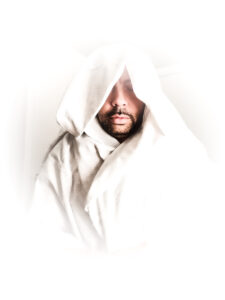
By the midpoint of those six years, my inner world had become an outer performance. I dressed the part — mystic clothing, head garments, a carefully curated aesthetic that announced to the world: I am more spiritually evolved than you.
This is what psychologists call Identity Foreclosure — the process of building your entire sense of self around a single identity so completely that questioning it feels existentially threatening. My spirituality was not something I practiced. It was something I was. To doubt the belief system was to dissolve the self.
The wardrobe was not vanity. It was armor. And the enemy it was protecting me from was my own doubt.
What Identity Foreclosure looks like
- You cannot separate your beliefs from your identity — criticism of ideas feels like a personal attack
- You surround yourself only with people who reinforce the worldview
- You perform the identity publicly and conspicuously — the costume becomes the message
- Any moment of doubt is quickly suppressed or spiritualized away
- The identity becomes more important than the truth
The New Age Ego
Here is what nobody tells you about spiritual ego: it does not look like arrogance. It looks like humility. It says things like "I'm just in tune with the universe" and "I've done the inner work." It wears the costume of service while quietly placing itself at the center of every story.
My new age ego was the engine driving all of it. It needed to be the most awakened person in the room. It needed the crystals, the cosmic correspondences, the clairvoyant certainty — because without them, it was just a person. Uncertain. Searching. Human.
The ego, in this framework, is not evil. It is afraid. And fear, dressed in mystical clothing, is still fear.
"I was not awakening. I was performing awakening — for an audience of one, who happened to also be the judge."
The Road Back to Reality
I did not have a dramatic breakdown. The return was slow, like ice melting. Small moments of honesty. A crystal grid that did not heal anything. A prediction that did not come true. A friend who asked a gentle, devastating question: "How do you know?"
How did I know? I had never asked myself that. The entire architecture depended on never asking that.
Gradually, I began moving my ego from the driver's seat to the back seat. This is not about eliminating the ego — the ego is part of being human, and it serves real functions. But an ego in the driver's seat of a spiritual identity will steer you off the road every time. An ego in the back seat can still speak. You just don't have to obey it.
I stopped wearing the costume. Not because there is anything wrong with meaningful clothing, but because I was wearing it to signal status — not to express genuine belief. I put the tarot cards away. Not because they are inherently harmful, but because I was using them as an oracle machine, not a reflective tool. I started researching again. I started saying, "I don't know."
That phrase — I don't know — was the first breath of real air I had taken in six years.
Living a Balanced Life
Today I live with balance. I am not anti-spiritual, and I am not anti-metaphysical. I hold wonder for the unknown without needing to colonize it with certainty. I can sit with mystery without turning it into a mythology about myself.
Schizotypy — Magical Ideation — is not a character flaw. It is a trait, a tendency of perception and pattern-recognition that can be a genuine gift when held thoughtfully. Artists, visionaries, and deep thinkers often score high on schizotypy scales. The difference is whether the trait serves you, or whether you have handed your life over to it.
If you see yourself in any part of this story — the cosmic certainty, the symbolic thinking, the identity built entirely around belief — I am not here to shame you. I am here to say: you can come back. And the coming back does not require you to become a skeptic or abandon all wonder. It only requires that you let your ego ride in the back seat for a while.
The view from the front seat is actually better without it driving.
Written from personal experience
This post reflects a firsthand journey through Schizotypy and Magical Ideation from 2016–2022. If you are navigating similar experiences, consider speaking with a licensed mental health professional who can provide proper support and guidance.
Hey there! We hope you love our fitness programs and the products we recommend. Just so you know, Symku Blog is reader-supported. When you buy through links on our site, we may earn an affiliate commission at no extra cost to you. It helps us keep the lights on. Thanks.
Disclaimer: The information provided in this discussion is for general informational and educational purposes only. It is not intended as medical or professional advice. Only a qualified health professional can determine what practices are suitable for your individual needs and abilities.