How to Start Building a Home Gym

  • Post author:
  • Post last modified:31 October 2025

There’s something magical about rolling out of bed and working out in your own space—no commute, no waiting for equipment, no judgment. Building a home gym is one of the best investments you can make in your health, but it can feel overwhelming when you’re staring at thousands of equipment options and conflicting advice. Let me walk you through exactly how to create a home gym that fits your goals, space, and budget.

[Note: This post contains affiliate links. If you purchase through these links, I may earn a small commission at no additional cost to you.]
Mac of All Trades

Start with Your "Why" and Your Space

Before you buy a single dumbbell, get crystal clear on what you actually want to achieve. Are you training for strength? Trying to lose weight? Maintaining general fitness? Your goals will dramatically shape your equipment choices. A powerlifter needs different tools than a yoga enthusiast or someone who loves high-intensity interval training.

Next, honestly assess your available space. Walk through your home and identify potential gym locations. That spare bedroom, garage, basement corner, or even a section of your living room could work. Measure everything—length, width, and critically, ceiling height. You’ll need this information when selecting equipment. A low basement ceiling might rule out certain exercises, while a small apartment might steer you toward foldable or compact equipment.

Consider the flooring situation too. If you’re on an upper floor or have downstairs neighbors, you’ll want to think about noise and vibration. Even if you own your home, dropping weights on hardwood isn’t ideal. Budget for rubber flooring, interlocking foam mats, or at minimum, a large exercise mat. This protects your floors, reduces noise, and makes the space feel intentional rather than improvised.

Essential Equipment First

Here’s where most people go wrong—they either buy too much too fast or they buy the wrong things first. Start with versatile, foundational equipment that enables hundreds of exercises. You can always expand later.

Adjustable dumbbells should be your first purchase if you’re working with limited space. A quality set like PowerBlocks or Bowflex SelectTech can replace an entire rack of traditional dumbbells, adjusting from 5 to 50+ pounds per hand. Yes, they’re pricier upfront (expect $300-600 for a good set), but they’re infinitely more practical than 10 pairs of fixed-weight dumbbells cluttering your space. If budget is tight, start with two or three pairs of traditional hex dumbbells in weights you’ll actually use frequently.

A quality exercise bench is non-negotiable for serious training. Look for an adjustable bench that can go flat, incline, and decline. This single piece unlocks chest presses, rows, shoulder work, step-ups, and countless other movements. Don’t cheap out here—a wobbly bench is dangerous. Expect to spend $150-400 for something solid that won’t collapse under load.

Resistance bands are criminally underrated. A good set with varying resistance levels costs $30-60 and provides an incredible workout, especially for warm-ups, mobility work, and training when you travel. They’re also perfect for assisted pull-ups if you’re building up to the real thing.

A pull-up bar is one of the highest-value investments in fitness. Doorway pull-up bars cost $25-40 and install in seconds without permanent mounting. If you have wall or ceiling space, a mounted bar is even better. Pull-ups, chin-ups, hanging leg raises, and simply hanging to decompress your spine are all invaluable exercises.

A quality yoga mat or exercise mat creates a designated workout zone and is essential for floor work, stretching, core exercises, and bodyweight training. Don’t grab the $10 thin mat that slides around—invest $30-60 in something thick and grippy.

Expanding Your Capabilities

Once you’ve mastered the basics and confirmed you’re actually using your gym regularly (give it three months), consider these additions based on your training style.

A barbell and weight plates open up serious strength training. An Olympic barbell runs $150-300 for quality, and you’ll want a selection of plates. Start with pairs of 45s, 25s, 10s, 5s, and 2.5s in pounds (or 20kg, 10kg, 5kg, 2.5kg, 1.25kg if you prefer metric). Bumper plates are ideal if you’re doing Olympic lifts or might drop the bar, but they’re bulkier and pricier than iron plates. Budget $400-800 for a starter barbell and plate set. You’ll also need a power rack or squat stands for safety—absolutely do not squat or bench press heavy weight without proper safety equipment. A basic power rack starts around $300-500, while a full commercial-grade rack can exceed $1,000.

A kettlebell or two adds dynamic movement options. Kettlebell swings are phenomenal for posterior chain development and conditioning. Start with one bell at a moderate weight—for most men, 35-53 pounds works; for most women, 18-35 pounds. Quality kettlebells cost $1.50-3.00 per pound.

Cardio equipment is where costs escalate quickly, so choose wisely. A basic spin bike or air bike provides brutal conditioning in minimal space ($300-800). Concept2 rowers are the gold standard for rowing machines and hold their resale value incredibly well, but they’ll run $900-1,000 new. Treadmills vary wildly from $500 budget models to $3,000+ commercial beasts—if you’re a serious runner, this matters; if you just want occasional walking or jogging, mid-range is fine. Jump ropes cost $10-30 and deliver exceptional cardio in zero space.

Cable machine or functional trainer provides smooth, constant tension and enables exercises difficult to replicate with free weights. These are pricey ($800-2,500) and space-intensive, so they’re typically for serious home gym enthusiasts. However, if you love cable work at commercial gyms, this might be worth prioritizing.

The Budget Strategy

Building a capable home gym doesn’t require a second mortgage. Here’s how to be smart about spending.

Buy used intelligently. Weight plates are weight plates—used iron plates cost half the price of new ones and work identically. Check Facebook Marketplace, Craigslist, or local garage sales. January is prime time for scoring deals from people abandoning New Year’s resolutions. However, be cautious with anything mechanical or with safety implications. A used treadmill might have hidden motor issues, and a bent barbell is dangerous.

Watch for sales strategically. Black Friday, New Year’s, and summer are when fitness equipment goes on deep discount. Sign up for email lists from major retailers like Rogue, Titan Fitness, Rep Fitness, or Dick’s Sporting Goods. Costco occasionally runs incredible deals on quality equipment.

Prioritize versatility over specialization. That fancy ab roller or specialized calf-raise machine probably isn’t necessary. Ask yourself: “Can I accomplish this with equipment I already have?” Usually, the answer is yes. Weighted crunches on your bench work fine; you don’t need a dedicated ab machine.

Consider the cost-per-use metric. A $600 adjustable dumbbell set seems expensive until you realize you’ll use it 200+ times per year for a decade. That’s less than 30 cents per workout. Meanwhile, that $25 ab gadget you use twice and forget about is actually more expensive.

Creating the Right Environment

Equipment is only part of the equation. Your gym needs to feel like a place you want to be.

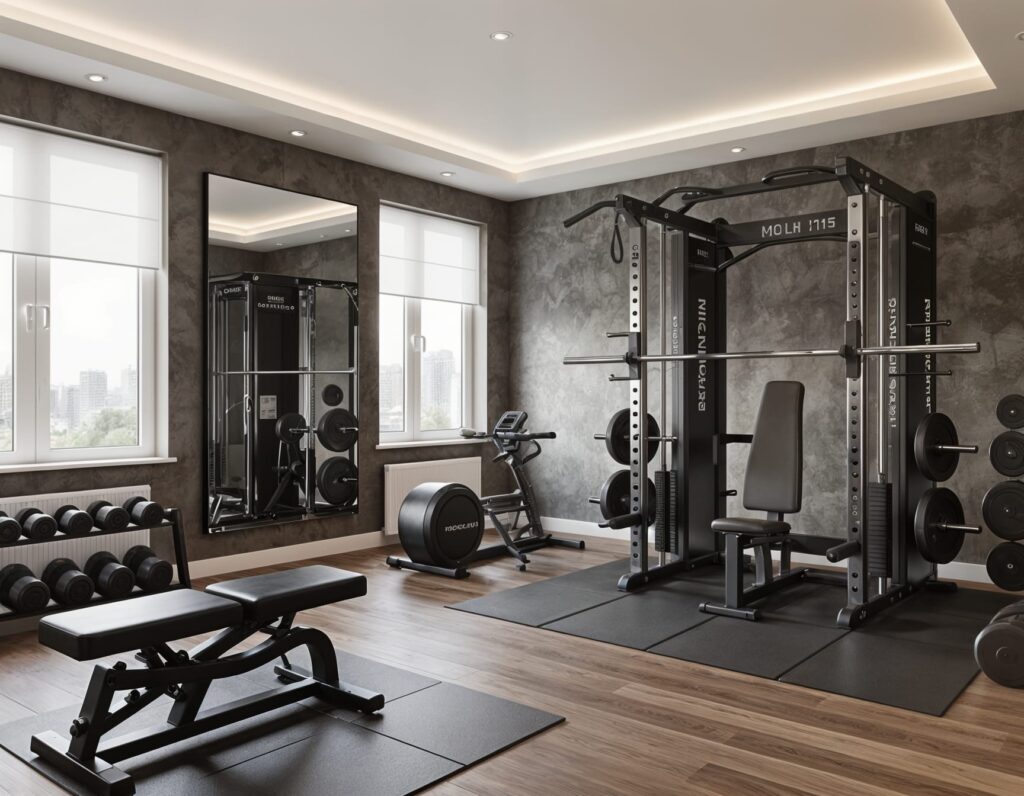
Lighting matters enormously. Dim, depressing spaces kill motivation. If you’re setting up in a basement or garage, invest in bright LED shop lights or even smart bulbs you can adjust. Natural light is ideal if available—position equipment near windows when possible.

Temperature control impacts whether you’ll actually use your space. A freezing garage in winter or a sweltering one in summer will sabotage your consistency. A space heater, fan, or even a small portable AC unit might be necessary depending on your climate.

Music and entertainment shouldn’t be afterthoughts. A decent Bluetooth speaker ($50-150) or a tablet mounted for workout videos transforms the experience. Some people mount TVs to watch shows while on cardio equipment—whatever keeps you moving consistently is worth considering.

Mirrors aren’t just vanity—they’re functional for checking form and making the space feel larger and more gym-like. A large mirror starts around $100-150 and dramatically improves the room’s feel.

Keep it organized. Weight plates scattered around are accidents waiting to happen. Invest in plate storage, dumbbell racks, or simple wall-mounted pegboards for bands and accessories. An organized space is inviting; chaos creates resistance to working out.

The Progressive Build Strategy

Don’t try to replicate a commercial gym on day one. Build progressively based on actual usage.

Phase 1 (Months 1-3): Start minimal with adjustable dumbbells, a bench, resistance bands, and a pull-up bar. Budget: $400-700. Master bodyweight movements, learn proper form, and establish the workout habit.

Phase 2 (Months 4-6): If you’re consistently using your gym, add either a barbell setup OR a cardio machine based on your primary goal. Budget: $400-1,000.

Phase 3 (Months 7-12): Fill gaps based on what you’re missing. If you went barbell in Phase 2, maybe add cardio now, or vice versa. Add specialty items like kettlebells or a cable system if budget allows.

Phase 4 (Year 2+): Now you can consider luxuries—upgraded versions of equipment you’ve worn out, specialized tools for specific goals, or aesthetic improvements like better flooring or wall art.

This approach prevents buyer’s remorse, spreads costs over time, and ensures you’re buying based on actual needs rather than imagined ones.
Common Mistakes to Avoid

Buying based on aspiration rather than reality. That Olympic lifting platform looks cool, but if you’ve never done a clean and jerk in your life, maybe learn the movement at a gym first before investing hundreds in specialized equipment.

Neglecting safety. Working out alone at home means nobody’s spotting you. Invest in safety equipment like power rack safety pins, use collars on barbells, and honestly assess when you need a spotter for certain lifts.

Forgetting about maintenance. Equipment needs care. Bars need occasional oiling, upholstery needs wiping down, machines need tightening. Set a reminder to do a quarterly maintenance check.

Ignoring ventilation. A stuffy, poorly ventilated space is miserable to work out in. If you’re in a basement or garage without windows, consider adding a fan or ventilation system.

Making It Stick

The most expensive home gym in the world is worthless if you don’t use it. Here’s how to ensure consistency.

Schedule workouts like appointments. Put them in your calendar and treat them as non-negotiable. The beauty of a home gym is flexibility, but that can backfire—”I’ll do it later” often becomes “I’ll do it tomorrow.”

Start small and build. Thirty minutes three times per week beats ambitious plans that fizzle after two weeks. Make it easy to win initially, then progressively challenge yourself.

Track your progress. Whether it’s a simple notebook or an app, recording your workouts creates accountability and lets you see improvement, which fuels motivation.

Find programming you enjoy. Wandering into your gym wondering what to do today is a recipe for inconsistency. Follow a structured program—there are thousands of free options online, or consider a modest investment in an app or coaching if that provides the structure you need.

Make it social if that motivates you. Invite friends to join you occasionally, share your progress online if that’s your thing, or do virtual workouts with distant friends. Solo training suits some people perfectly; others need community even in a home setting.

The Bottom Line

A functional home gym can cost anywhere from $500 to $5,000+ depending on your goals, space, and whether you’re buying new or used. The sweet spot for most people is starting with $600-1,000 of foundational equipment and expanding over the first year based on what you actually use and enjoy.

The real value isn’t in the equipment itself—it’s in the consistency and convenience it enables. No commute time, no waiting for equipment, no monthly fees, and the freedom to work out at 6 AM or 11 PM in whatever you want to wear. Over time, a home gym pays for itself in saved membership fees and, more importantly, in the improved health and strength that comes from removing barriers to consistent training.

Start simple, buy smart, and focus on using what you have rather than accumulating what you don’t need. Your future self—the one who’s stronger, healthier, and wondering why you didn’t start sooner—will thank you.

Mac of All Trades

Hey there! We hope you love our fitness programs and the products we recommend. Just so you know, Symku Blog is reader-supported. When you buy through links on our site, we may earn an affiliate commission at no extra cost to you. It helps us keep the lights on. Thanks.

Disclaimer: The information provided in this discussion is for general informational and educational purposes only. It is not intended as medical or professional advice. Only a qualified health professional can determine what practices are suitable for your individual needs and abilities.