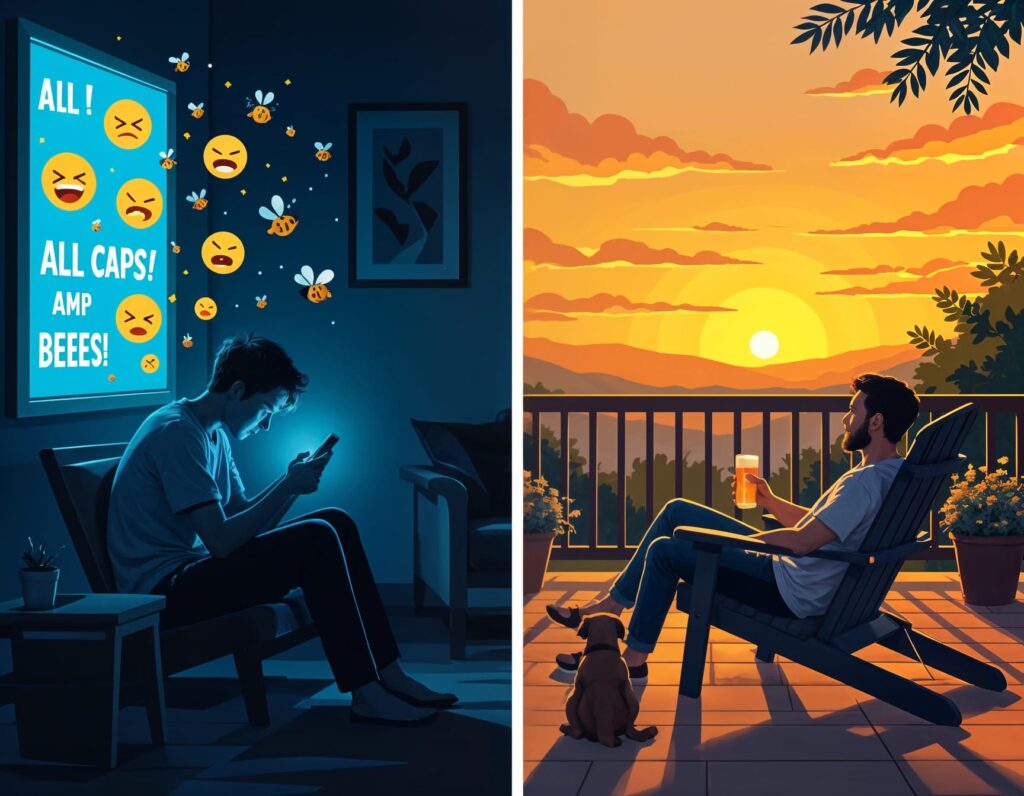
There was a time when my phone was a portal to chaos, and I was an eager tourist in the land of outrage. Every morning started the same way: coffee in one hand, phone in the other, scrolling through the digital battleground that social media had become. Political tirades, religious feuds, racial arguments—all served up fresh before I’d even brushed my teeth. And I loved it.
I was a connoisseur of meltdowns, a sommelier of schadenfreude. Someone would post a political opinion, and within minutes, the comments section would explode like a firework factory hit by lightning. I’d watch strangers eviscerate each other over healthcare policy, immigration, gun rights, abortion—you name it. The angrier they got, the more I’d lean in, refreshing the page to catch every update, every increasingly unhinged reply.
The Glory Days of Rage-Scrolling
Back then, I could tell you exactly who in my feed was losing it over what. Susan was having a complete breakdown because someone wished her “Happy Holidays” instead of “Merry Christmas.” Marcus was typing paragraphs in all caps about why everyone who disagreed with his economic views was personally responsible for society’s collapse. Jennifer had just discovered a hot-button racial issue and was ready to torch anyone who didn’t immediately align with her newly acquired perspective.
I’d screenshot the best ones. Save them. Share them with friends. “Can you BELIEVE what this person just posted?” we’d say to each other, drunk on the drama of it all. We were feeding on fury, gulping down gallons of other people’s emotional breakdowns like we were at an all-you-can-eat buffet of human suffering.
The religious debates were particularly spectacular. Someone would post a Bible verse, and suddenly you had atheists, Catholics, Protestants, Muslims, and New Age religious people all colliding in a supernova of theological warfare. Everyone was going to hell, nobody understood the “true meaning” of anything, and I was there for every single comment, every nested reply, every passive-aggressive emoji reaction.
Political posts were the premium vintage of tears. Election season was my Super Bowl, my World Cup, my Olympics all rolled into one. I’d watch people I’d known for years reveal themselves as either saints or demons depending on which candidate they supported. Friendships imploded in real-time. Family members blocked each other. And I sat there, scrolling, refreshing, watching it all burn with a kind of sick fascination.
The Turning Point
But somewhere along the line, something shifted. Maybe it was the hundredth time I saw the same argument play out with different people. Maybe it was realizing I’d wasted three hours watching strangers fight about something neither would remember in a week. Maybe it was the creeping awareness that I was using other people’s pain as entertainment, like a modern-day gladiator spectator, but the blood was emotional instead of physical.
I remember the exact moment I changed. It was a Tuesday evening. Someone had posted something inflammatory about race relations—didn’t even matter what side they were on. The comments were already at 347, and I was about to dive in with my popcorn when I just… stopped. My thumb hovered over the screen, and for the first time, I asked myself: Why am I doing this?
What was I getting out of watching people spiral? What did it matter if someone I barely knew was having a public meltdown about their political candidate losing or their religious views being challenged? These people were genuinely upset—hurting, even—and I was treating it like a reality TV show.
The realization hit like cold water: I’d become addicted to outrage. Not even my own outrage—other people’s outrage. I was a secondary consumer of anger, feeding off the emotional labor of people who were genuinely invested in these issues. And for what? So I could feel superior? So I could tell myself I was more rational, more balanced, more enlightened?
The Great Detox
I didn’t quit social media entirely. I’m not a monk. But I made a conscious decision to change how I engaged with it. No more diving into comment sections. No more hate-reading posts I knew would enrage half the people who saw them. No more refreshing to see if the argument got worse.
Instead, I started doing something radical: I cracked open a beer.
Not as a replacement addiction or some kind of alcoholic escape—just as a symbol of a new approach to life. When I saw someone melting down online now, instead of screen-shotting and sharing, I’d close the app, grab a cold one from the fridge, and sit on my porch. Or play with my dog. Or call a friend to actually talk about something that mattered.
The difference was immediate and profound. Suddenly, I had time. Time I didn’t even realize I’d been losing. Hours of my life that had been spent watching people fight about things that, honestly, had little to no impact on my actual day-to-day existence. Those hours became mine again.
Tears and Beers
Here’s the thing about drinking tears: they’re salty, bitter, and they leave you feeling empty. There’s no nutrition in them, no sustenance. You’re just consuming the emotional waste products of other people’s stress, and it does nothing for you except maybe provide a brief hit of dopamine when you feel morally or intellectually superior.
Beer, on the other hand—beer is honest. It doesn’t pretend to be anything other than what it is. It’s a choice to relax, to let go, to acknowledge that not everything requires my attention or my opinion. It’s a boundary between me and the digital chaos.
I’m not saying I don’t care about important issues anymore. I vote. I donate to causes I believe in. I have conversations with actual humans about things that matter. But I’ve stopped treating social media like it’s the battleground where civilization’s fate will be decided.
Because here’s what nobody tells you about the outrage machine: it’s designed to keep you engaged, angry, and coming back for more. The algorithms don’t care about your mental health or your relationships or whether you’re spending your finite time on earth doing things that actually bring you joy. They care about clicks, engagement, time spent on platform.
The View from Here
These days, when I see someone having a public meltdown about politics, race, or religion, I feel something different than I used to feel. Not schadenfreude. Not superiority. Mostly just… sympathy. Because I remember what it was like to be that invested in winning an argument with strangers, to believe that if I could just find the right words, the perfect comeback, I could change someone’s mind or “win” the debate.
Spoiler alert: you can’t. And even if you could, what would you win? A stranger’s grudging acknowledgment? A few likes from people who already agreed with you? The hollow satisfaction of having been “right” in a comment section that will be forgotten by tomorrow?
Now I drink beers and think about other things. I think about the book I’m reading, or the project I’m working on, or the conversation I had with my neighbor yesterday. I think about the things that are actually in my life, not the simulated reality of other people’s rage.
An Invitation
So here’s my invitation to you, fellow former tear-drinker: put down the phone. Step away from the comment section. Let other people have their meltdowns without an audience. You’re not missing anything except stress you don’t need and drama that isn’t yours.
Crack open a beer. Or a soda. Or a fancy kombucha—I don’t care. The point isn’t the beverage. The point is choosing something that’s for you, that brings you a moment of peace, that reminds you that your life is more than the sum of other people’s online arguments.
I used to drink tears, but now I drink beers. And honestly? The view is better from here. The world didn’t stop spinning. Important things still happen. I’m just not marinating in the emotional wreckage of strangers anymore.
And you know what? I don’t miss it. Not even a little bit.
So here’s to choosing peace over chaos, real life over digital drama, and beers over tears. May your feed be calm, your comment sections unread, and your beer always cold.
Cheers.
Hey there! We hope you love our fitness programs and the products we recommend. Just so you know, Symku Blog is reader-supported. When you buy through links on our site, we may earn an affiliate commission at no extra cost to you. It helps us keep the lights on. Thanks.
Disclaimer: The information provided in this discussion is for general informational and educational purposes only. It is not intended as medical or professional advice. Only a qualified health professional can determine what practices are suitable for your individual needs and abilities.