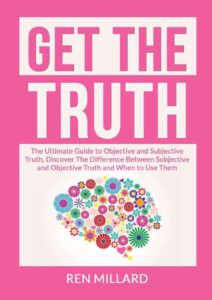
There’s a peculiar tension in modern discourse. Two people can witness the same event, examine the same evidence, and walk away with completely different accounts of what happened. It’s not just disagreement—it’s as if they’re living in separate realities. At the heart of this divide lies a philosophical question that’s escaped the academy and invaded our daily lives: What counts as truth?
[Note: This post contains affiliate links. If you purchase through these links, I may earn a small commission at no additional cost to you.]
Understanding the Divide
Objective truth refers to facts that exist independently of what anyone believes, feels, or perceives. The Earth orbits the Sun whether anyone acknowledges it or not. Water freezes at 0°C at standard pressure regardless of your opinion about it. These truths are verifiable, consistent, and exist outside human consciousness.
Subjective truth, by contrast, exists in the realm of personal experience and interpretation. Your pain is real to you. Your emotional response to a piece of music is genuine. The meaning you derive from a work of art is valid within your experience. These truths are internal, personal, and can vary dramatically from person to person.
Here’s where it gets complicated: these two types of truth have always coexisted peacefully in their respective domains. The problem emerges when subjective experience begins claiming authority over objective facts, or when we start treating verifiable reality as merely one perspective among many.
The Expansion of Subjective Territory
Something has shifted in recent decades. The boundary between these two types of truth has become porous, with subjective claims increasingly encroaching on territory traditionally governed by objective verification.
Consider how we now discuss topics that once seemed straightforward. Scientific findings are dismissed if they conflict with personal beliefs. Historical events are reframed based on how they make people feel. Expertise is questioned not on methodological grounds but because it challenges someone’s worldview. The phrase “my truth” has become commonplace, as if truth were something we each possess individually rather than something we collectively discover.
This isn’t simply about postmodern philosophy trickling down from universities, though that’s part of the story. It’s about a fundamental reorientation of how people relate to reality itself.
Why the Shift?
Several forces are driving people toward subjective frameworks:
The democratization of voice through social media has created an environment where every opinion can find an audience. When your perspective can reach thousands instantly, it gains a weight it might not deserve based purely on evidence. Personal testimony becomes as authoritative as scientific research simply by virtue of engagement metrics.
Identity politics has elevated lived experience to the highest form of knowledge. If your identity group experiences something, who is anyone else to question it? This has created epistemological zones where only insiders can speak with authority, and where feeling becomes a form of knowing that trumps external verification.
The complexity of modern life overwhelms our capacity for verification. We can’t personally verify climate data, vaccine efficacy, or economic statistics. We must trust institutions and experts. But when trust in institutions erodes—through actual failures, perceived bias, or deliberate disinformation—people retreat to what feels true based on their direct experience and the experiences of those they trust.
Emotional reasoning has become culturally ascendant. If something feels wrong, it must be wrong. If an idea makes you uncomfortable, it must be harmful. This conflation of emotional response with truth-value transforms internal states into external facts.
Digital echo chambers allow us to curate reality itself. Algorithms feed us content that confirms our existing beliefs. We can effectively choose our own facts, surrounding ourselves with sources that tell us what we want to hear. Over time, this creates the sensation that our subjective experience reflects objective reality—after all, everyone in our feed agrees.
The Imagination Land Effect
You called it “imagination land,” and there’s something profound in that characterization. When subjective truth dominates, reality becomes malleable, shaped by desire and belief rather than by what actually is. It’s not quite imagination—these people genuinely believe their perceptions reflect reality—but it shares imagination’s quality of being constructed rather than discovered.
This creates a paradox: people living by subjective truth often claim to be more authentic, more genuine, more in touch with “real” reality than those bound by supposedly cold, objective facts. They’re not escaping truth; they’re claiming access to a deeper truth that transcends mere facts.
But here’s the problem: reality doesn’t care what we believe. A building constructed according to feelings about structural integrity will collapse. Medicine based on what feels healing rather than what demonstrably works will fail patients. Societies organized around pleasant fictions rather than uncomfortable truths will face consequences that no amount of belief can wish away.
The Cost of Subjectivity
When subjective truth extends beyond its proper domain—personal meaning, aesthetic judgment, moral values—we lose our shared reality. And without shared reality, we lose the ability to solve collective problems.
How do you address climate change when people’s “truth” about it diverges completely? How do you manage a pandemic when subjective interpretations of risk supersede epidemiological data? How do you maintain democracy when people can’t agree on basic facts about what happened?
The cost isn’t just political gridlock. It’s a fracturing of our ability to reason together, to persuade one another, to change our minds when presented with evidence. If everyone lives in their own truth, there’s no common ground for dialogue, only competing realities shouting past each other.
What's at Stake
This isn’t about being cold or unfeeling toward people’s experiences. Subjective truth has real value. Your pain matters even if it doesn’t show up on a medical scan. Your interpretation of your own life is valid even if others would frame it differently. Meaning-making is a deeply human activity that can’t be reduced to data points.
But we must maintain the distinction. We must recognize that while all truths are truths, not all truths are the same kind of truth. Personal meaning doesn’t get to override physics. Sincerely held beliefs don’t alter historical facts. Feelings, however intense, aren’t evidence.
The challenge of our moment is learning to honor subjective experience without letting it colonize the domain of objective fact. To be both compassionate toward people’s feelings and committed to reality as it actually is. To understand that kindness doesn’t require pretending that all claims are equally valid.
Finding Our Way Back
The path forward isn’t to dismiss subjective experience as irrelevant—that would be its own form of denial. Instead, we need to rebuild literacy about different types of truth and their appropriate domains.
We need to relearn humility: the recognition that reality exists independently of our beliefs about it, and that we might be wrong. We need to cultivate curiosity: the willingness to investigate what’s actually true rather than simply defending what we wish were true. We need to recover the value of expertise: the understanding that some people, through training and study, know more about certain topics than others.
Most importantly, we need to rediscover the satisfactions of engaging with reality on its own terms. There’s a peculiar freedom in accepting what actually is, even when it’s uncomfortable. Reality may be indifferent to our desires, but it’s also reliable. It’s the ground we all stand on together.
Living in imagination land might feel safer, more comfortable, more affirming. But it’s a fragile existence, vulnerable to every collision with the world as it actually is. The question facing us isn’t whether we can afford to embrace objective truth. It’s whether we can afford not to.
Hey there! We hope you love our fitness programs and the products we recommend. Just so you know, Symku Blog is reader-supported. When you buy through links on our site, we may earn an affiliate commission at no extra cost to you. It helps us keep the lights on. Thanks.
Disclaimer: The information provided in this discussion is for general informational and educational purposes only. It is not intended as medical or professional advice. Only a qualified health professional can determine what practices are suitable for your individual needs and abilities.